AI-ready engineering data
Documents are not treated as files to OCR. They become structured tags, parts, attributes, relationships and provenance that industrial systems can trust.

Deep industrial AI platform | P&ID value chain
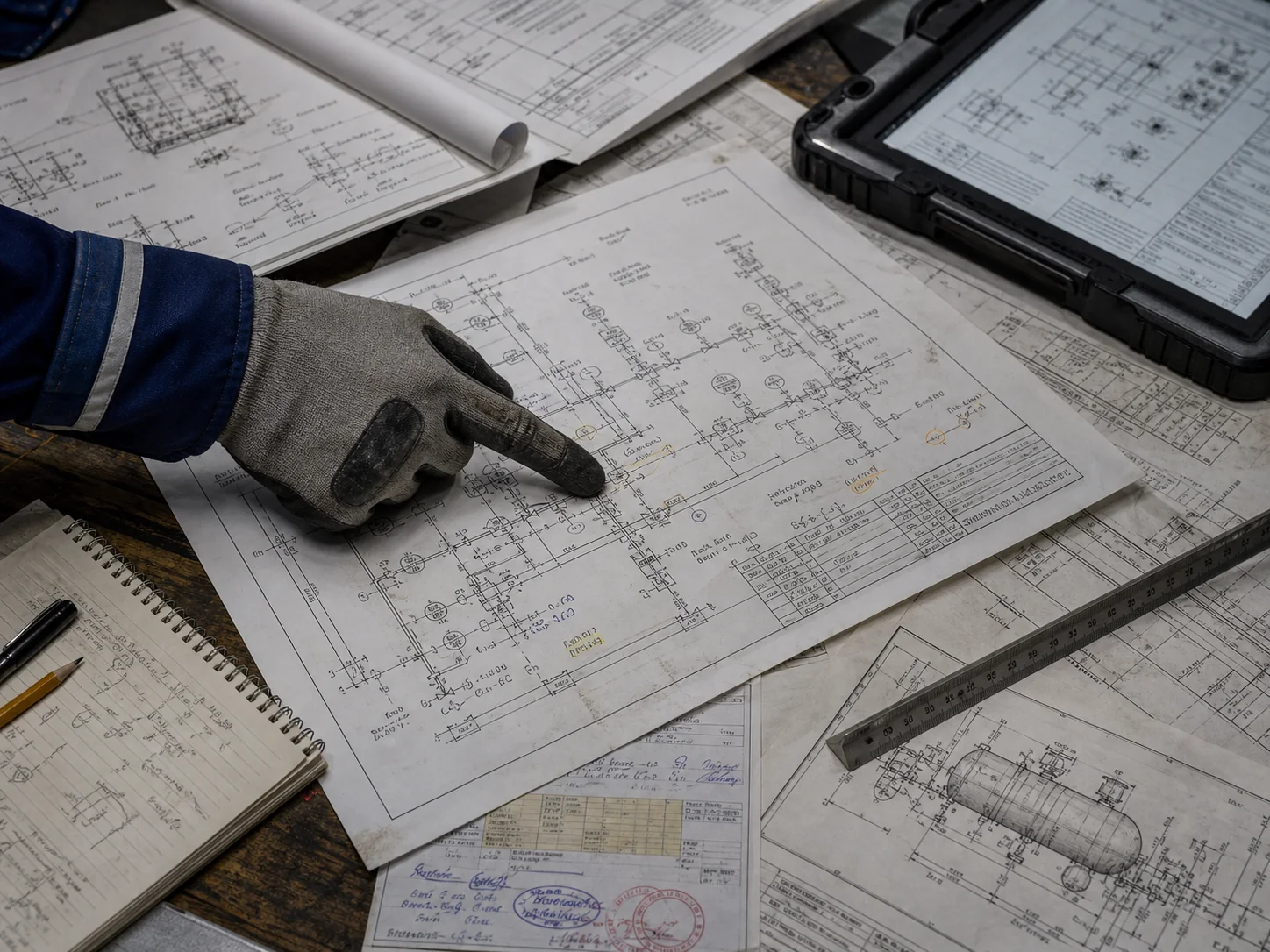
Axiovia is built on proprietary Vision and Language Intelligence, converting symbols, tags, lines and equipment into governed data for CAD, CMMS, ERP and digital twins.
Business impact
Plant owners need faster digitization, service partners need better project economics, and Axiovia captures platform value through AI extraction, neutral handoff and partner-driven delivery scale.
Documents are not treated as files to OCR. They become structured tags, parts, attributes, relationships and provenance that industrial systems can trust.
Axiovia builds context first, then applies supervised agents across RFQ, reconciliation, register generation, migration and handover workflows.
Every automation path carries source grounding, confidence, exception routing and human review so outputs can move into production systems.
The platform is built to connect with engineering, procurement, asset, CMMS and digital-twin environments rather than becoming another data silo.
What we do
Axiovia does not need to own every destination CAD system. The platform recognizes, extracts and structures the engineering data, then hands off clean neutral files for partner-led CAD build, validation and QA/QC.
Axiovia industrial AI platform
Vision Intelligence reads symbols, topology and drawing structure. Language Intelligence maps tags, standards and attributes. Together they produce CAD-ready, audit-ready industrial data.
VISION INTELLIGENCE
Detects layouts, tables, symbols, connected lines, stamps and annotations across P&IDs, schematics, scans and multi-discipline records.
LANGUAGE INTELLIGENCE
Maps terms, units, tags, part numbers and clauses to standards, then checks each value against domain rules.
Every extracted value carries provenance, confidence, validation state and a target handoff format before it enters SPPID, AVEVA, AutoCAD, asset systems or twin platforms.
Use case portfolio
The same recognized P&ID and datasheet data can support CAD migration, tag indexes, MTO, equipment master data, line lists, twin population and governed QA workflows.
Convert PDF and scanned P&IDs into intelligent CAD-ready data using AI symbol, line and tag recognition.
Generate structured instrument indexes with IDs, types, service context, specifications and export-ready records.
Parse OEM datasheets into structured ratings, materials, dimensions, performance curves and master-data attributes.
Extract material takeoff, valve quantities, pipe lists, equipment lists and line registers for procurement and asset workflows.
Feed twin and asset platforms directly through neutral-format exports, avoiding long waits for complete native CAD migration.
Extend extraction into safety-critical tags, relief paths, discrepancy checks and destination CAD build workflows with expert sign-off.
Axiovia begins with drawing and document intelligence, but the product architecture climbs into structured data, system connectors and controlled industrial agents.
The agent layer is valuable because it is fed by engineering data that generic platforms and operations tools cannot reliably read from the trapped backlog.
Axiovia does not compete head-on in worker safety, generic quality vision or predictive maintenance. It supplies the live engineering-data backbone those systems need.
Axiovia product modules
The product suite keeps Axiovia distinct: the platform owns recognition, mapping and neutral output quality while partners complete destination-specific CAD build and sign-off.
Converts scanned and vector P&IDs into recognized symbols, tags, lines, equipment and connectivity.
Exports structured tag and instrument data for CMMS, ERP, engineering and twin workflows.
Extracts OEM equipment attributes, materials, dimensions, ratings and performance data.
Creates valve, pipe, fitting and equipment quantities for procurement and project controls.
Publishes neutral structured data for digital twin and asset-management platforms.
Coordinates partner validation, destination CAD build and engineering sign-off.
Product system
The roadmap direction is architectural: extract from mixed sources, build trusted registers, publish neutral formats, and support partner workflows that scale across destination CAD environments.
Bundle MTO, datasheet extraction, drawing conversion and review workflows into repeatable modules that deepen the proprietary industrial corpus.
Corpus quality and data accuracyStandardize master tag registers, document registers, migration outputs, RFQ creation and PO-to-quote checks so each deployment becomes faster and more product-like.
Reusable delivery architectureSynchronize approved data with engineering, procurement, maintenance and twin environments while keeping live asset records current.
Data backbone and integrationsUse the validated knowledge backbone to supervise doc-to-ops agents, reasoning workflows and generative engineering research without losing human governance.
Governed autonomyArchitecture stack
PDF, DWG, DOCX, XLSX, images and email become machine-readable industrial source material.
Vision Intelligence and Language Intelligence read structure, symbols, tables, tags and engineering context.
Tags, parts, equipment, documents, attributes and relationships become a governed industrial knowledge graph.
MTOs, mapped datasheets, tag registers, line lists and trade datasets move into governed review.
Agents, APIs and connectors synchronize approved data with AVEVA, Bentley, SAP MM, Maximo and asset systems.
The accumulated corpus supports higher-order work such as document reasoning, generated engineering drafts and layout optimization.

Industries
The lead wedge is highest where scanned P&ID archives block CAD migration, twin readiness, CMMS population and maintenance workflows at scale.
Highest scanned-P&ID volume across refineries, offshore assets, pipelines and MRO programs.
Multi-thousand-drawing migration programs where manual redraw is economically unworkable.
Aging fleets, substations and regulated infrastructure with scattered OEM datasheet records.
Compliance-heavy operations where traceable equipment data matters before native CAD migration.
Budget-sensitive infrastructure where AI compresses the cost of digitizing paper-only archives.
Remote processing sites and thin engineering teams needing MTO and equipment-data extraction.
Deployment evidence
Every deployment should make the neutral output cleaner, the partner QA/QC effort lower, and the commercial case for recurring platform revenue stronger.
Automated symbol, line and tag recognition is the primary value creation point in the migration chain.
DEXPI XML, CSV, Excel and JSON allow review and correction before data enters destination CAD systems.
Service partners use the same team to bid more scope, reduce manual effort and capture higher margins.
P&ID migration economics
Axiovia connects VisionGraph, DocGraph, AssetGraph and FlowGraph outputs with BoMs, RFQs, tag registers, migration deliverables, connectors and live asset records. Authorized clients manage those outputs in the secure portal.
Open client portalLeadership and expertise
A cross-functional team combining industrial transformation, AI product engineering, enterprise commercialization and specialist P&ID delivery.

Strategic advisory and industrial transformation

Applied AI and product engineering

Enterprise sales and market development
Team members
Our engineering team turns complex industrial documents and workflows into reliable, intuitive software.

Backend systems and document intelligence

Full-stack engineering and 3D interfaces
Technical advisor
Specialist guidance strengthens technical validation, destination-system delivery and engineering-data quality.

P&ID digitization, CAD migration and industrial delivery
Show us the drawings, datasheets, email trails, decisions and systems involved. We will define a focused proof that measures data quality, cycle time and repeatability.
Map the corpusIdentify source documents, formats, counterparties, decisions and target systems.
Define the proofAgree on data quality, validation, connector and cycle-time measures.
Climb the stackConvert the proof into a repeatable workflow, connector or live data product.